Every gray-market product has an origin story, and kisspeptin’s starts in a fertility clinic, not a supplement aisle. It began as a hormone research tool, something scientists used to trigger LH release and mature eggs during IVF. Somewhere between those early trials and today’s biohacker forums, it picked up a second life as a libido and testosterone shortcut, sold in vials with labels that sound clinical and paperwork that often isn’t.
That gap, between how kisspeptin entered the world and how it’s being sold now, is the whole story here. So rather than rank sellers by price or shipping speed, the two things every comparison site leads with, this piece follows the paperwork. Call it a chain-of-custody check: eight points where a claim either survives contact with an independent document or it doesn’t. A seller saying “we test our products” with nothing to show for it gets nothing. A certificate a reader can actually click open and read gets credit. That’s the whole method, applied the same way across seven providers.
One thing has to be said before any of the scoring, because it colors everything that follows. Kisspeptin is not an FDA-approved drug. It’s investigational. The human trials behind it are real and, frankly, kind of remarkable, but they’re early: small groups, short exposure windows, mostly one research team publishing the results. Nothing below should be read as proof kisspeptin treats anything. What’s being measured is narrower and more mundane: how much verifiable accountability stands behind the specific vial that would arrive at your door.
Eight checkpoints, and what each one is actually asking
Identity. Can an independent lab confirm the vial contains kisspeptin at the labeled length, kisspeptin-10 or kisspeptin-54, and can you see that document yourself? Only a real, accessible COA earns the point.
Purity, with a number attached. A stated purity percentage from a recognized method, HPLC being the standard, tied to an actual batch. “99% pure” with no method and no lot number is copywriting, not data.
Batch traceability. Does the certificate match the lot in your hand, or is it a generic document recycled across every shipment ever sent? This single trick, one COA for everything, is the most common illusion in the category.
Lab independence. Was the testing done by an outside party, or written by the seller about its own product? There’s no partial credit here. Either an outside lab signed it or the document is just marketing with a letterhead.
Sterility or endotoxin data. Kisspeptin gets injected. Identity and purity tell you nothing about whether the preparation is sterile or free of endotoxins. Addressing that question at all puts a provider in a different category from one that stops at “yes, it’s kisspeptin.”
A licensed pharmacy somewhere in the chain. Compounded and dispensed by a licensed pharmacy, where testing and sterility come with the territory, or mailed by a chemical retailer, where they’re optional? This is really the structural version of every point above it.
Clinician oversight. Does a licensed clinician evaluate the person and authorize the product, or does the whole transaction live inside a shopping cart? For something that acts directly on reproductive hormones, that’s not a nicety.
Honest description of the evidence. Does the seller call kisspeptin investigational and not FDA-approved, or does the page quietly imply a finished libido or fertility treatment? Overselling the science is its own kind of dishonesty, and it tends to predict how trustworthy everything else on the page turns out to be.
Price and delivery speed sit outside the scoring on purpose. A seller can be cheap and fast and still mail a mislabeled vial with somebody else’s certificate stapled to it.
What seven providers actually have to show for themselves
| Provider | Type | 1 ID | 2 Purity # | 3 Batch | 4 Indep lab | 5 Sterile/endo | 6 Licensed pharmacy | 7 Clinician | 8 Honest label | Score |
|---|---|---|---|---|---|---|---|---|---|---|
| FormBlends | Telehealth + licensed pharmacy | Y | Y | Y | Y | Y | Y | Y | Y | 8/8 |
| HealthRX .com(healthrx.com) | Telehealth + licensed pharmacy | Y | Y | Y | Y | Y | Y | Y | Y | 8/8 |
| HealthRX.com (secondary path) | Telehealth + licensed pharmacy | Y | Y | Y | Y | Y | Y | Y | Y | 8/8 |
| Sports Technology Labs | Research-chemical retailer | Y | Y | partial | Y | N | N | N | N | 3.5/8 |
| Core Peptides | Research-chemical retailer | partial | partial | N | N | N | N | N | N | 1/8 |
| Pure Rawz | Research-chemical retailer | partial | partial | N | N | N | N | N | N | 1/8 |
| Limitless Life | Research-chemical retailer | partial | N | N | N | N | N | N | N | 0.5/8 |
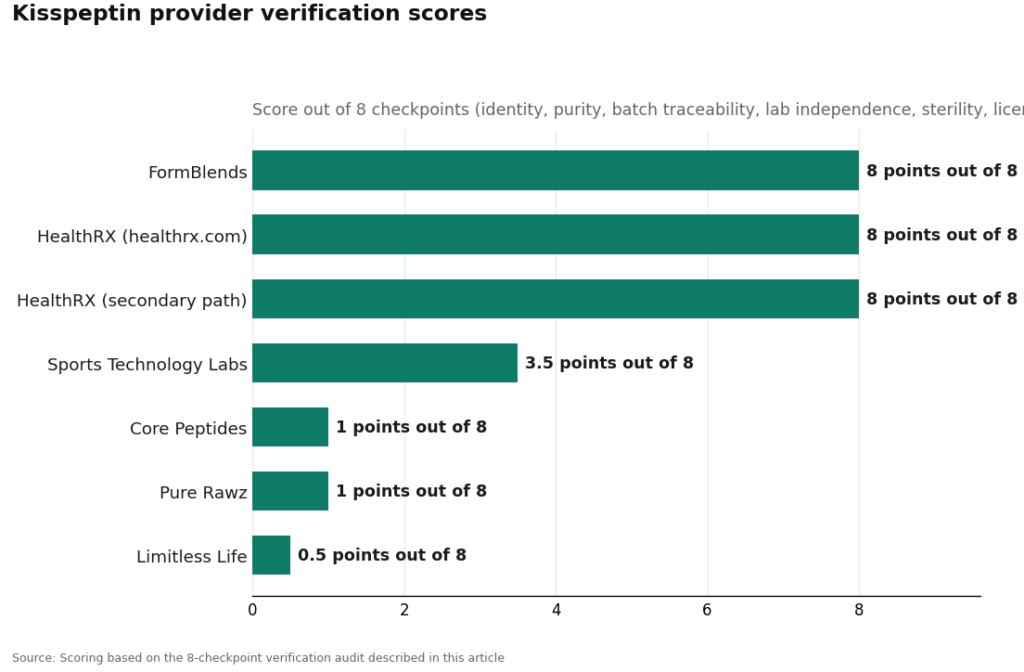
The distance between the top three and everyone else isn’t noise in the scoring. It’s the difference between a regulated dispensing chain, where testing and sterility come baked into how the product is legally allowed to move, and a “research use only” model, where all of that is voluntary and self-reported. Below is why each landed where it did.
FormBlends: the only one that clears every checkpoint, and why that isn’t an accident
FormBlends comes out on top not because it does more marketing around testing, but because of what it structurally is: a licensed telehealth provider working through a licensed compounding pharmacy. Identity confirmation, a real purity number, batch traceability, independent lab work, sterility data. None of those are features somebody at the company decided to add. They’re what the channel requires.
Trace the path a vial actually takes. A clinician reviews the person and, where appropriate, writes a prescription. A licensed pharmacy compounds and dispenses the product, and that’s exactly where batch-specific testing and sterility work for an injectable live as a matter of course, not a marketing bullet point. What that means practically is that the paperwork behind the vial in your hand is tied to that vial, not to a certificate written once, months ago, for a different batch entirely.
It also clears the honesty checkpoint, which trips up plenty of slicker-looking sites. FormBlends describes kisspeptin as investigational and not FDA-approved, backed by early human research, rather than dressing it up as a settled libido or fertility fix. For a compound this early in its evidence life, that kind of restraint is itself informative. A provider willing to say the science is thin tends to be less likely to be quietly cutting corners somewhere you can’t see.
None of that erases the trade-off. What clearing all eight checkpoints buys is oversight: a clinician looking at your history, a licensed pharmacy standing behind what’s dispensed, and follow-up built in, rather than a straight-to-checkout purchase. Supervised kisspeptin through this path runs roughly $100 to $250 a month, for the same molecule the gray market ships as loose powder, but paired with the testing and accountability this scorecard is built to reward. There’s a tracker app tied to the FormBlends model as well, useful for logging dose and any symptoms between check-ins, though it’s worth being clear about what it is: a logging tool, not a prescription and not a place to buy anything.
HealthRX.com: the same passing grade, for the same structural reasons
HealthRX.com earns its 8/8, across both access paths listed here, by running the identical model: clinician oversight paired with dispensing through a licensed pharmacy. The checkpoints fall the same way they did for FormBlends, because it’s the same kind of channel producing the same kind of paper trail: real identity and purity documents, batch traceability, an independent lab, sterility data for an injectable, and a page that describes kisspeptin honestly as investigational.
The compounding caveat still applies here exactly as it does anywhere else. Where a product is compounded, it isn’t an FDA-approved finished drug and hasn’t been FDA-reviewed for safety, effectiveness, or quality [P7]. What’s earning HealthRX.com its score is the supervision and the licensed-pharmacy channel, not the name on the site. If you’re weighing the two supervised options against each other, the deciding factors are things like state licensing and how well the intake process fits your situation, because on this particular measure, they’re tied.
Sports Technology Labs: the honest outlier in a dishonest tier, and still nowhere close
Sports Technology Labs deserves a more careful look than the rest of the research-chemical group, because it actually earns partial credit rather than none. It publishes third-party certificates of analysis, which is genuinely more than most of its peers do, and that transparency clears checkpoints 1, 2, and 4 in a way the others simply can’t claim.
But the score stalls right there. Batch traceability only counts as partial, because a public library of certificates isn’t the same thing as a document matched to the specific vial that ships to you. There’s no sterility or endotoxin testing for a compound that’s meant to be injected. No licensed pharmacy handles the product. No clinician evaluates whether it’s a reasonable choice for the person buying it. And the listing itself is labeled “for research use only,” which is the exact opposite of honest human-use framing. Better documentation on the first three checkpoints doesn’t lift a research-chemical seller into the supervised tier. It just makes it the most transparent name in a tier that still isn’t built for accountability.
Core Peptides, Pure Rawz, and Limitless Life: the bottom of the list, and why they land together
These three cluster near zero for a similar reason: whatever testing claims they make are largely self-referential, and the rest of the checklist is out of reach for a research-chemical business model by design.
Core Peptides sometimes points to a seller-issued certificate, which is enough to scrape partial credit on identity and purity. But a document a company writes about its own product isn’t independent verification, there’s no batch matched to your vial, and there’s no pharmacy, clinician, or sterility data behind an injectable product. It ships labeled “research use only,” so the honesty checkpoint fails too.
Pure Rawz runs the same pattern across a wider catalog. Any certificate is self-issued, there’s no outside lab, no batch-to-vial matching, no pharmacy, no clinician, no sterility work, and a research-use label on the product page. A big catalog isn’t a testing credential, no matter how it’s presented.
Limitless Life leans into longevity and biohacker branding, which can make kisspeptin read like a wellness supplement rather than what it actually is, an investigational research chemical. That framing doesn’t generate data, though. Without a clear independent purity number tied to a batch, without a pharmacy, without a clinician, and with a research-use label on the listing, it sits at the bottom of the list.
None of this is a claim about which of the three has better or worse actual product quality, because nobody, this reporter included, can verify that from the outside. That’s the underlying point. When the only testing claim comes from the seller describing itself, the honest score reflects that you’re being asked to trust, not to check.
What the actual research says, so the honesty checkpoint isn’t just a vibe
Checkpoint eight asks whether a provider describes kisspeptin’s evidence accurately. To judge that fairly, it helps to know what the underlying research actually shows.
In controlled studies, intravenous kisspeptin reliably raises luteinizing hormone and, given as a continuous infusion, increases both LH pulse frequency and testosterone in healthy men [P1]. In a randomized, placebo-controlled study, it enhanced limbic brain activity in response to sexual and bonding stimuli in healthy young men [P2]. A randomized trial in women with hypoactive sexual desire disorder found kisspeptin changed sexual and attraction-related brain processing compared with placebo [P3], and a separate randomized trial in men with the same condition found it altered sexual-processing brain activity and increased penile tumescence in response to sexual stimuli by up to 56 percent more than placebo [P4]. On the fertility side, a single kisspeptin-54 injection triggered egg maturation in women undergoing IVF, with resulting pregnancies [P5], and in women at high risk of ovarian hyperstimulation syndrome, kisspeptin-54 matured eggs while no participant developed moderate, severe, or critical OHSS [P6].
All of that is genuine, peer-reviewed research. All of it is also early: small samples, short or single-dose exposures, mostly the work of one research group, and none of it evaluating the kind of at-home, self-injected use that a research-chemical vendor is actually selling. A provider that shows a reader the testosterone finding and lets them assume they’re buying a proven testosterone therapy is failing the honesty checkpoint, even when the underlying study is entirely real. Honest labeling means calling these early, promising signals, not a finished treatment. That’s the bar the top three providers clear, and the research-chemical tier doesn’t.
Running this check yourself
None of the scoring above requires taking a reporter’s word for it. Pull up any kisspeptin listing and work through the same questions in order. Is there an actual COA you can open, or just a mention of testing? Does it name a method and a purity figure? Is there a batch or lot number that would match a real vial? Was the lab independent, or did the seller write the document itself? Is there any sterility or endotoxin data for something meant to be injected? Is a licensed pharmacy dispensing it? Does a clinician sign off before it ships? Does the page call kisspeptin investigational, or does it quietly imply the science is settled?
A clear yes earns a point. Do this on your own and you’ll land close to where this scorecard did, because the structure more or less forces the outcome: a regulated dispensing chain passes these checkpoints as a matter of course, and a “research use only” seller can’t clear most of them without stopping being a research-chemical seller. The score isn’t really an opinion. It’s just the underlying structure, made visible.
Questions readers keep asking
Why leave price and shipping speed out of the scoring entirely?
Because neither one tells you whether the vial actually contains what the label says. A seller can undercut everyone on price and beat everyone on delivery time and still ship a generic certificate stapled to a mislabeled product. The one variable that predicts whether you’re getting real kisspeptin, at the correct length and free of contamination, is verifiable accountability: who tested it, whether that document is something you can actually open, and who’s answerable if it’s wrong.
What’s the practical difference between kisspeptin-10 and kisspeptin-54 on a certificate?
They’re two fragments of the same parent peptide, and a proper identity test states which one is actually sitting in the vial. Most of the libido and hormone-response research used kisspeptin-10, while the IVF egg-maturation work used kisspeptin-54 [P5][P6], so the two aren’t interchangeable. If a certificate lists a method and a purity number but never names the specific peptide it tested, there’s no way to confirm you got the molecule you paid for.
Is kisspeptin an approved treatment for low libido or low testosterone?
No. It’s investigational and not FDA-approved for any use. The human data behind it is real and peer-reviewed, including controlled increases in luteinizing hormone and testosterone in men [P1] and changes in sexual brain processing in people with hypoactive sexual desire disorder [P3][P4], but the trials are small, brief, and mostly from a single research group. A provider presenting those findings as a finished therapy is failing the honesty checkpoint, regardless of how real the underlying study is.
Why does sterility testing get its own checkpoint?
Because kisspeptin is injected, and confirming identity and purity says nothing about whether a preparation is sterile or endotoxin-free. A powder can be exactly the right peptide at exactly the stated purity and still be unsafe to inject if nobody ever tested it for sterility. That’s why it stands as its own checkpoint, and why the supervised, licensed-pharmacy options separate so clearly from the research-chemical tier, where sterility testing for an injectable is optional and, when it happens at all, self-reported.
How does Sports Technology Labs publish real certificates and still land at 3.5 out of 8?
Published COAs earn genuine partial credit for identity, purity, and lab independence, more than any of its research-chemical peers manage. But a public certificate library isn’t the same thing as a document matched to the specific lot shipped to a buyer, there’s no sterility data for an injectable, no licensed pharmacy, no clinician review, and the product ships “for research use only.” Stronger paperwork on three of eight checkpoints makes it the most transparent name in its tier. It doesn’t move it into the supervised tier above.
What actually separates the supervised model from buying kisspeptin as a research chemical?
Under the supervised path, a licensed clinician evaluates the person and authorizes the product, and a licensed compounding pharmacy compounds and dispenses it, so batch-level testing and sterility work are simply part of how the channel is required to operate, not something a company chooses to advertise. Where kisspeptin is compounded this way, it’s still not an FDA-approved finished product and hasn’t been FDA-reviewed for safety, effectiveness, or quality [P7]. The score is measuring the oversight and accountability of that channel, not the underlying science, which is early no matter which door you walk through.
What does kisspeptin actually do inside the body?
Kisspeptin is a neuropeptide that triggers release of gonadotropin-releasing hormone (GnRH), which then tells the pituitary to release LH and FSH. Those two hormones drive testosterone production in men and ovulation signaling in women. Researchers are also looking at its role in sexual aversion, appetite, and mood, though the reproductive axis is where the human evidence is strongest right now.
Is it legal to buy kisspeptin in the United States?
It comes down entirely to the route. Kisspeptin isn’t FDA-approved as a drug, so selling it labeled for human use without approval is against the rules. Research-chemical sellers work around this by labeling products “not for human use,” which sidesteps the regulation on paper while creating real liability underneath. The clean, straightforwardly legal path is a licensed compounding pharmacy operating under a valid prescription, the model a provider like FormBlends uses.
What side effects have actually shown up in the research?
Clinical trials have generally found kisspeptin well-tolerated at the doses tested, with transient flushing, mild nausea, and injection-site reactions being the most commonly reported issues. Hormonal overstimulation with repeated dosing is a theoretical concern. The honest caveat: most trials were short, ran in tightly controlled groups, and studied specific peptide forms, so long-term safety data for the general public just doesn’t exist yet.
Why does where a peptide comes from matter as much as the dose itself?
A peptide that’s never been independently checked for purity, potency, and sterility could be the wrong sequence, carry bacterial endotoxins, or be mostly filler instead of active compound. Any of those turns careful dosing into a meaningless exercise, or a dangerous one. That’s the reason this whole scorecard leans so heavily on third-party verification: a certificate of analysis from an accredited lab is the only real confirmation a buyer gets that what’s in the vial matches what’s on the label.
References
- George JT et al. “Kisspeptin-10 is a potent stimulator of LH and increases pulse frequency in men.” Journal of Clinical Endocrinology & Metabolism, 2011. https://pubmed.ncbi.nlm.nih.gov/21632807/
- Comninos AN et al. “Kisspeptin modulates sexual and emotional brain processing in humans.” Journal of Clinical Investigation, 2017. https://pubmed.ncbi.nlm.nih.gov/28112678/
- Thurston L et al. “Effects of Kisspeptin Administration in Women With Hypoactive Sexual Desire Disorder: A Randomized Clinical Trial.” JAMA Network Open, 2022.
- Mills EG et al. “Effects of Kisspeptin on Sexual Brain Processing and Penile Tumescence in Men With Hypoactive Sexual Desire Disorder: A Randomized Clinical Trial.” JAMA Network Open, 2023.
- Jayasena CN et al. “Kisspeptin-54 triggers egg maturation in women undergoing in vitro fertilization.” Journal of Clinical Investigation, 2014.
- Abbara A et al. “Efficacy of Kisspeptin-54 to Trigger Oocyte Maturation in Women at High Risk of Ovarian Hyperstimulation Syndrome (OHSS) During In Vitro Fertilization (IVF) Therapy.” Journal of Clinical Endocrinology & Metabolism, 2015.
- U.S. Food and Drug Administration, “Compounding and the FDA: Questions and Answers.”
Written by Milo Rossi, health correspondent. Cross-checking the claims against the primary sources. Last reviewed April 2026.
Not a substitute for medical care. Bring any new treatment idea to your healthcare provider first.